Most accountants are not short on work. They are short on time to put towards the right work. A busy day can involve hours spent chasing documents, resending reminders, and answering the same client questions.
That friction rarely feels like a system problem. It just feels like the job. But much of it comes down to how information travels between your practice and your clients.
Accounting client portal software helps you run a more efficient practice while improving the client experience. Here is where practitioners lose the most time, and how the right software helps recover it.
Scattered Communication Slows Everything Down
Client conversations often live across email threads, phone notes, and messages from different staff members. When you need context on a request, you end up searching inboxes or chasing down a colleague.
Clients run into the same wall. They send a message and have no way of knowing whether it reached the right person or when to expect a response.
A client portal keeps all communication attached to the client record and visible to your team. You respond faster, and clients stop sending follow-ups to confirm receipt.
Document Collection Becomes a Bottleneck Without Structure
Most firms underestimate how much time goes toward collecting documents. You send a request, wait, and follow up. You then repeat that cycle for every client who has not responded.
That same process exposes your practice to risk. Sensitive documents traveling through unsecured channels create liability that is easy to overlook until something goes wrong.
Client portal software provides clients with a secure place to upload documents directly to their accounts. Automatic reminders handle the follow-ups, and files arrive organized and ready to use.
Task Visibility Keeps Work Moving Forward
Without clear task tracking, requests go unaddressed. You may assume someone is handling a follow-up. Meanwhile, they’re waiting on you for information, and neither side knows where the holdup is.
That disconnect has a real cost. Staff moves between priorities without knowing what needs attention first, and small oversights turn into missed deadlines.
A client portal gives both sides a view into the current status of every task. You see what is pending or awaiting client input. Clients see progress without needing to ask. Check-ins become shorter because the answers are already there.
Email Creates Security and Compliance Risks
Email was not built for exchanging sensitive documents. You can send a file to the wrong address in seconds and have no way to pull it back.
There is also the compliance side. Regulators expect documented controls over how client data moves. A chain of email attachments does not meet that standard.
Client portals keep file exchange within an encrypted environment. With built-in access controls and activity logs, you can see exactly who accessed a file and when. Your entire team knows exactly where to find a record when a regulator or client asks for it.
Reducing Follow-Ups Saves Time for Everyone
Every follow-up email or phone call adds a small delay. Across a full client roster, those delays stack up into hours your team could spend elsewhere.
Portals reduce that friction by keeping instructions, requests, and reminders in one place. Clients know exactly what you need and where to submit it, without a phone call to get there.
Your team spends less time coordinating and more time on work that requires professional judgment.
Improving the Client Experience Without Extra Work
Clients rarely voice frustration directly. They simply become harder to reach, slower to respond, or quieter about referrals.
A portal gives them one place to submit files and stay informed. For clients who struggle to keep track of what they have sent, it works as a tax document organizer that they can use without guidance from your team.
That kind of experience builds your firm’s reputation.
Freeing Time for Higher-Value Work
Administrative tasks consume hours that could go toward advising clients or building the practice. When coordination and follow-ups fill the day, the work that requires professional judgment gets pushed aside.
Portals handle the routine automatically. Requests go out, and documents arrive without your team managing each step.
The time recovered goes toward client work and analysis that require your expertise.
Why Centralization Makes a Difference
The true value of a client portal lies in centralization. When tasks and documents live together, your team spends less time locating information and more time acting on it.
Centralization also brings consistency to the practice. You can manage client work and onboard new staff without rebuilding context from scratch each time.
Patterns also become easier to spot. When everything runs through one system, you can see where requests stall or deadlines stretch. If a particular stage keeps slowing down, you have the visibility to act on it.
A Practical Step Toward Efficiency
Client portal software addresses inefficiencies that many firms accept as normal. The time lost to manual follow-ups and scattered files adds up.
And most of it is avoidable.
The shift does not require an overhaul. One system handles the coordination while your team focuses on work that requires their judgment.
Clients stay with firms that make the experience easy. A client portal is the most direct way to get there.
Video

Infographic
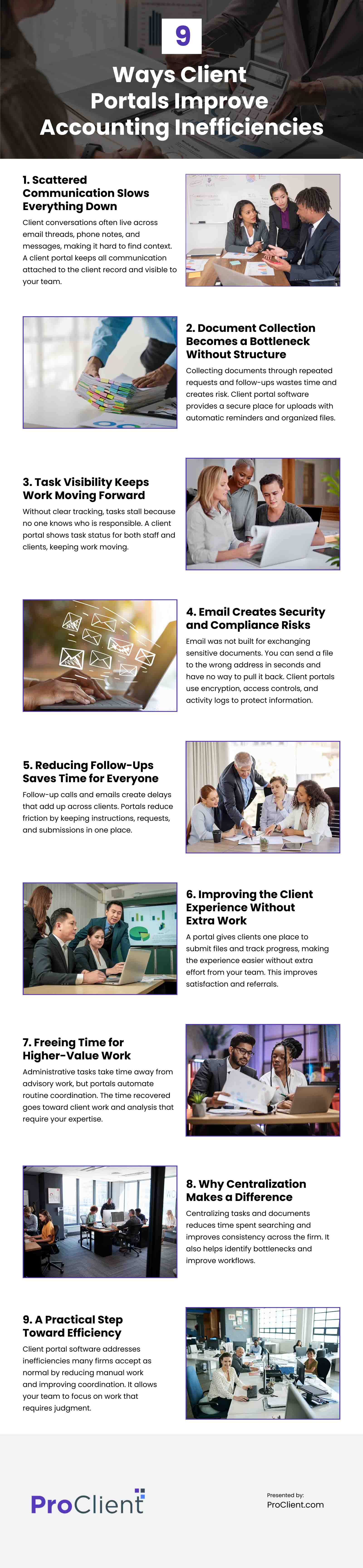
Many accounting firms aren’t short on work; they’re losing time to inefficient administrative processes that pull focus from higher‑value client services. This infographic shows how client portals can streamline workflows and reduce common accounting inefficiencies.