As your accounting practice grows, some tools that once made life easier can start slowing you down. You might be jumping between emails and spreadsheets or relying on software that no longer supports the way your team works. You might also notice tasks taking longer or client onboarding feeling heavier than it should.
If any part of that sounds familiar, your current system may not be supporting your growth. That’s where upgrading your accountants’ practice management software becomes the next logical step. However, knowing when to take that step can feel unclear, especially when day-to-day work keeps you busy.
Here’s how to identify the tipping point:
1. You’re Spending More Time Managing Work Than Doing It
One of the biggest signs that your system is no longer functioning as it should is the extra time spent on completing routine tasks. You might find yourself stopping to verify a detail that should already be visible. Or a routine task drags on because the system makes it hard to see the progress or ownership behind it.
This friction slows everything down and increases your risk of errors. At this point, investing in a modern platform that lets you automate tasks and coordinate everything in one place becomes the best way to support your team.
2. Client Expectations Have Outpaced Your Capabilities
Clients now expect fast communication and clear updates at every stage of their engagement. When your tools make it hard to share documents securely or send timely reminders, staying on top of those expectations becomes a challenge.
Modern practice management systems give you a branded client portal where key documents and messages stay in one place. It brings order to your workflow and raises the standard of your client experience. If you’ve ever watched a prospect choose another firm because their process felt smoother, your technology deserves a closer look.
3. Your Workflows Are Rigid, Manual, or Built Around Workarounds
If your current setup forces you to work around its limits through manual processes or repeated effort, it’s a sign that the system no longer supports your goals. You shouldn’t need multiple tools just to collect documents and keep projects organized.
Your software should adapt to the way you work, not the other way around. The right platform enables you to tailor your pipelines and automate follow-ups, eliminating the patchwork of disconnected tools you’ve been relying on.
4. Your Team Is Growing, But Your Systems Aren’t Scaling
As your firm adds more clients and team members, the complexity of your operations grows exponentially. If your practice management system doesn’t scale with you, you’ll quickly run into bottlenecks and inconsistent service delivery.
You need tools that make collaboration easy across teams and give you a clear view of progress. A scalable system ensures your internal operations stay as organized and efficient at 500 clients as they were at 50.
5. You Can’t Easily Measure Performance or Spot Bottlenecks
Growing your firm requires clear insight into how work progresses each day. You need visibility into who owns each task and which parts of a project are falling behind. If that clarity is missing, it becomes difficult to make informed decisions.
A modern system gives you reporting tools and dashboards that reveal where delays happen and highlight the areas that require attention.
Three Key Triggers That Signal It’s Time to Upgrade
If you’re still unsure whether now is the time, ask yourself:
- Are you missing deadlines or losing clients because of disorganized processes or communication gaps?
- Do your staff members frequently complain about tools being confusing, outdated, or inefficient?
- Have you had to hire extra admin help just to manage tasks your software should be handling?
If you answered yes to even one of those, it’s likely time to consider a better solution.
Upgrading Shouldn’t Mean Disrupting
One of the biggest concerns about switching systems is the fear of disruption. You worry that migrating data might interrupt your workflow or slow your team down. But with the right platform and onboarding process, the transition can be smooth, and the long-term benefits far outweigh the short-term adjustment.
Modern platforms offer migration support and training resources to make the switch manageable and worthwhile. And because today’s systems are often cloud-based, you can access your workflows from anywhere, making them ideal for firms with distributed or remote teams.
Choose a System That’s Built for Accountants
Not all practice management tools are built the same. Some are generic project management platforms stretched across too many industries. Others are legacy products with interfaces that slow you down.
You need a system designed for accountants and the realities of tax season and client confidentiality. Look for a platform that offers encrypted storage and role-based access control, along with automation that fits accounting workflows.
When you choose a platform built around your needs, you spend less time adjusting settings and more time serving clients.
Your System Should Support Your Growth
Your practice management system should work as hard as you do. It should make your days smoother, your clients happier, and your business more scalable. If your current platform is creating more problems than it solves, it may be time to look for a setup that aligns with how your firm operates.
Upgrading your tech stack is an investment in your firm’s future. The right system supports growth, carries the workload during busy seasons, and gives your team the structure they need to perform at a higher level.
Video

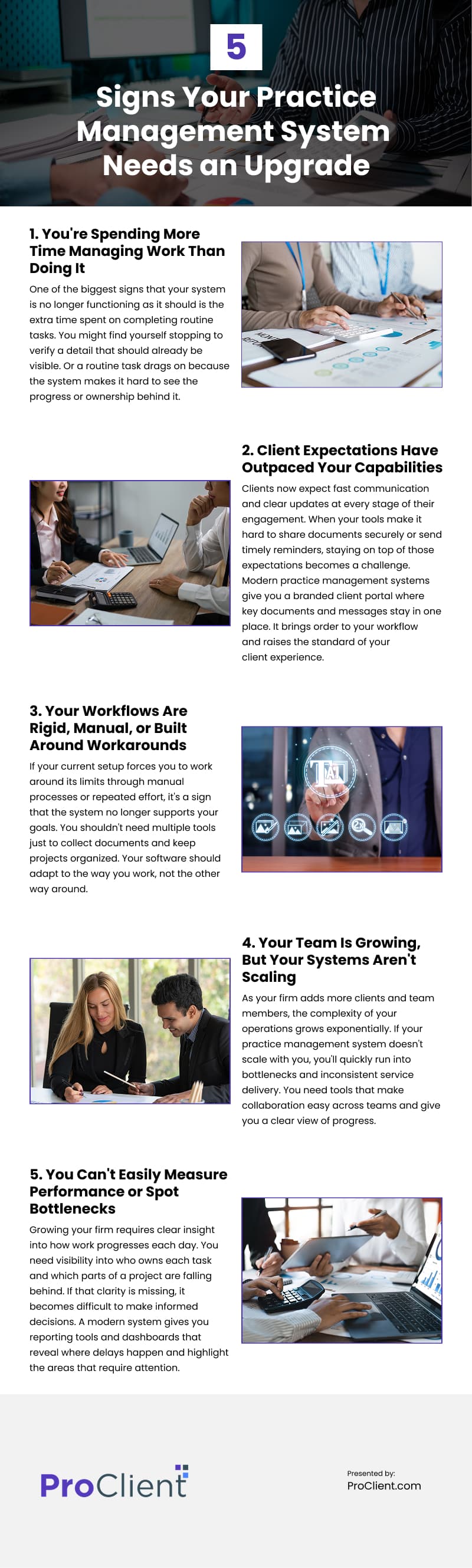
Infographic
As your accounting practice grows, once‑efficient tools can become distractions that pull focus from client service. If you’re spending more time tracking tasks and verifying details than supporting clients, it may be time to upgrade your systems. Explore this infographic for signs your practice management setup needs improvement.